


PræXis
Sustained Practice
PræXis is the discipline of returning.
It does not add steps.
It does not replace the cycle.
It does not move beyond Breath.
It is what happens when engagement becomes rhythm.
If you have not completed a recent cycle, begin there.

What It Is
PræXis supports steadiness over time.
Through repetition:
Patterns become visible.
Timing becomes clearer.
Proportion becomes more natural.
Nothing dramatic changes.
Familiarity deepens.


When to Enter
PræXis may be appropriate when:
• The cycle feels familiar.
• Capacity is generally stable.
• There is no urgency driving practice.
If capacity is low, return to Breath.
If urgency is high, stabilise first.
There is no requirement to continue.
Modes of Practice
All modes are equal.
None is advanced.
All return to the same structure.
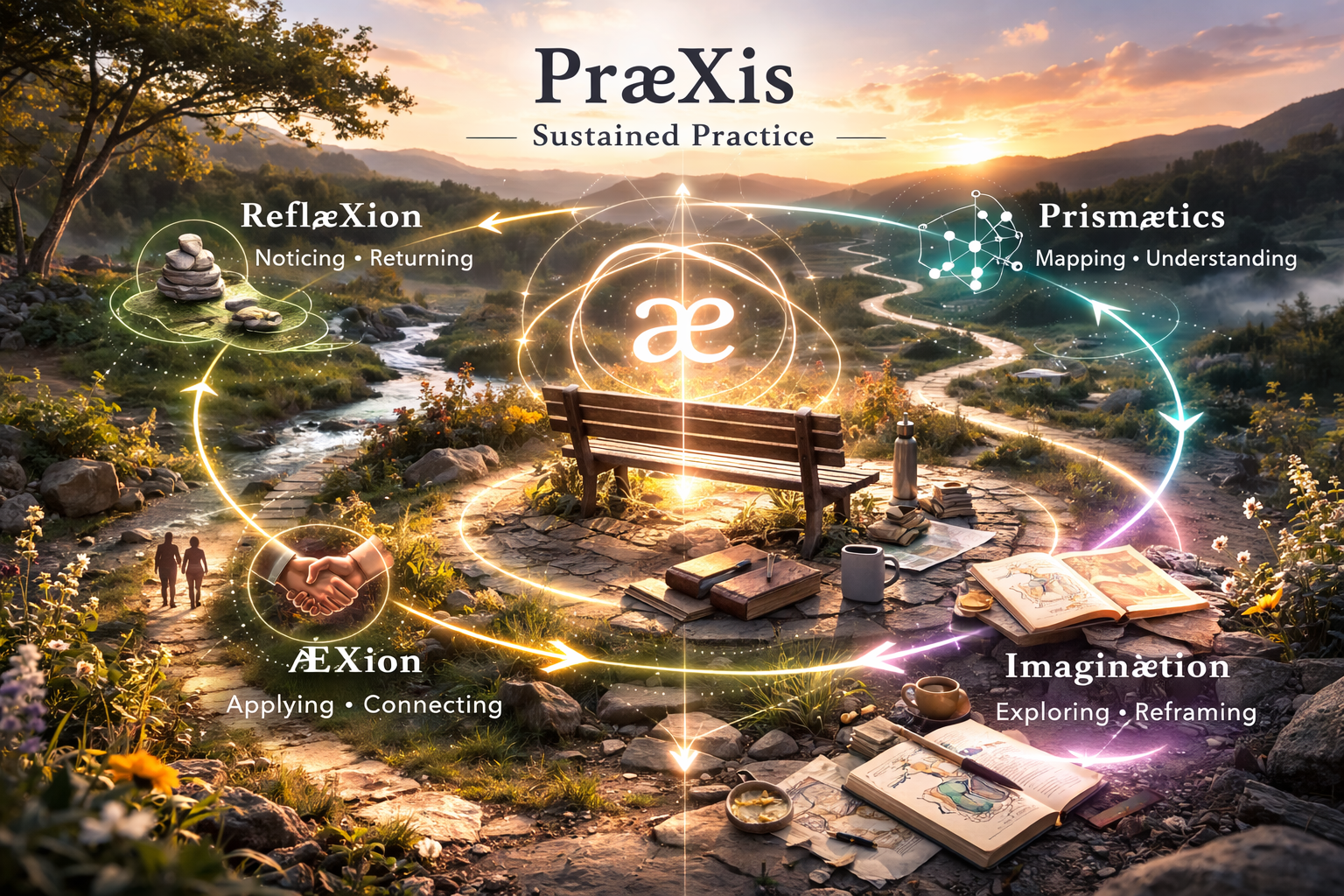
ReflæXion
Structured noticing over time.
• Weekly reflection loops
• Pattern logging
• Capacity tracking
• Gentle review
Light repetition. Quiet clarity.
Prismætics
Mapping patterns across systems.
• Relationship mapping
• Load and limit awareness
• Timing observation
• Relational impact reflection
Structure before action.
Imaginætion
Generative reframing within containment.
• Alternative interpretations
• Proportionate future rehearsal
• Symbolic exploration grounded in mapped limits
Possibility without escalation.
Return to Breath at any stage.
ÆXion
Applied relational engagement.
• Conversation preparation
• Boundary calibration
• Ethical decision reflection
• Organisational application
Action remains proportionate.

Clarifications
-
No.
PræXis does not move beyond Breath → Capacity → Discern → Engage.
It is the repetition of the same structure over time.
-
No.
The cycle is sufficient.
PræXis is optional sustained practice.
-
A single cycle clarifies a moment.
PræXis builds familiarity across moments.
It makes pattern recognition steadier.
-
No.
It does not diagnose, treat, or replace professional support.
If distress is significant, seek appropriate care.
-
No.
PræXis is a practice structure.
It does not require adherence to ideology.
-
No.
PræXis does not optimise output.
It supports proportionate engagement.
Sometimes the proportionate action is pause.
-
When capacity allows.
Light repetition is sufficient.
Intensity is not required.
-
Pause.
Return to Breath.
If distress persists, seek external support.
PræXis is not meant to amplify overwhelm.
-
Yes — with containment.
Collective engagement requires attention to capacity, timing, and relational safety.
It should not be used as performance management.
-
Nothing collapses.
PræXis is not cumulative achievement.
It is available whenever you return.
-
No.
The structure remains consistent.
Your engagement with it will vary.
-
No.
It supports steadiness.
Transformation, if it occurs, is emergent — not guaranteed.
-
Yes.
Non-engagement can be proportionate.
PræXis includes the possibility of stopping.
-
No.
It supports clearer decision-making.
It does not remove responsibility.
-
PræXis is structured engagement.
Any meaning-making that emerges belongs to the participant.
The structure itself is secular.